

X-Ray Sources
Compact, ultrashort X-ray sources driven by high-power lasers
X-rays are powerful tools for exploring the structure and dynamics of matter, from biological samples and advanced materials to dense objects and rapidly evolving physical systems. At the Scottish Centre for the Application of Plasma-based Accelerators (SCAPA), we develop laser-driven X-ray sources that exploit the interaction of intense, ultrashort laser pulses with plasma to produce high-brightness radiation.
By combining high-power femtosecond lasers with laser–plasma accelerators, SCAPA investigates new approaches to generating ultrashort X-ray pulses. These sources offer opportunities for high-resolution imaging, ultrafast measurements and scientific applications that benefit from compact radiation sources.
How are X-rays generated?
Betatron radiation
When an intense laser pulse propagates through a plasma, it can accelerate electrons to relativistic energies. As these electrons oscillate transversely within the plasma wakefield, they emit radiation known as betatron radiation.
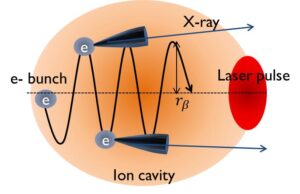
This process produces bright, ultrashort X-ray pulses with a small source size and partial spatial coherence. These properties make betatron radiation particularly attractive for phase-contrast imaging, high-resolution imaging and the investigation of rapid processes in matter.
Laser–plasma accelerators can generate energetic electron bunches and X-ray radiation within a compact interaction region, offering an alternative approach to conventional accelerator-based radiation sources.
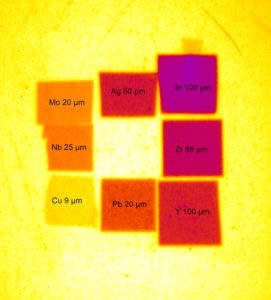
Bremsstrahlung radiation
Another route to X-ray generation is bremsstrahlung, which occurs when energetic electrons are decelerated or deflected by the electric fields of atomic nuclei in a target.
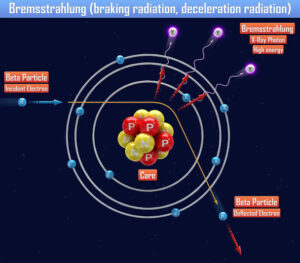
At SCAPA, laser-accelerated electrons can be used to generate bremsstrahlung radiation by interacting with suitable materials. Depending on the electron energy and target configuration, this process can produce a broad spectrum of high-energy X-rays and gamma rays.
Betatron radiation and bremsstrahlung offer complementary characteristics, enabling researchers to investigate different source configurations for specific experimental requirements.
Applications of laser-driven X-ray sources
High-resolution and phase-contrast imaging
X-ray imaging is widely used to reveal internal structures that cannot be observed using visible light. In addition to conventional absorption imaging, phase-contrast techniques exploit changes in the phase of X-rays as they pass through a sample.
This can enhance the visibility of weakly absorbing structures, including soft biological tissues and low-density materials. Laser-driven X-ray sources offer opportunities to investigate high-resolution imaging, phase-contrast radiography and X-ray computed tomography, with potential applications in biomedical research and materials characterisation.
Ultrafast probing of matter
The ultrashort duration of laser-driven X-ray pulses makes them valuable probes of rapidly evolving systems. Researchers can use X-ray pulses to investigate structural changes, transient states and dynamic processes that occur on extremely short timescales.
Potential applications include studying laser-driven plasmas, phase transitions, material dynamics and the evolution of complex molecular systems. By synchronising X-ray pulses with a controlled excitation, pump–probe experiments can capture snapshots of a system as it changes over time.
Biological and structural research
X-rays can reveal structural information at length scales that are difficult to access using optical techniques. Laser-driven sources provide opportunities to explore X-ray diffraction, imaging and structural characterisation of biological specimens and other complex materials.
These approaches may support research into biomolecular structure, the behaviour of biological materials and the development of advanced imaging methods.
Industrial inspection and materials science
High-energy X-rays can penetrate materials and reveal internal features, defects and variations in density. Laser-driven bremsstrahlung sources offer opportunities to investigate radiographic inspection, non-destructive testing and the characterisation of dense or complex objects.
Potential research areas include material integrity, radiation damage and the behaviour of materials under extreme conditions.
Advancing compact X-ray source technology
Realising the full potential of laser-driven X-ray sources requires continued development of source stability, photon yield, spectral properties, beam transport and diagnostic techniques. At SCAPA, research into laser–plasma interactions and accelerator performance supports the development and characterisation of these radiation sources.
By combining expertise in high-power lasers, plasma physics, particle acceleration and X-ray diagnostics, SCAPA provides a platform for collaborative research into emerging X-ray technologies and their applications in science, healthcare and industry.
We welcome engagement with academic and industrial partners interested in developing X-ray sources, exploring new imaging techniques and applying ultrashort radiation pulses to challenging scientific problems.