

Particle Acceleration
Accelerating particles with high-power lasers
Particle accelerators are essential tools for exploring the fundamental properties of matter, developing new technologies and advancing scientific research. At the SCAPA, we develop and apply laser-driven plasma accelerators to generate high-energy particle beams and explore their applications across science, medicine and industry.
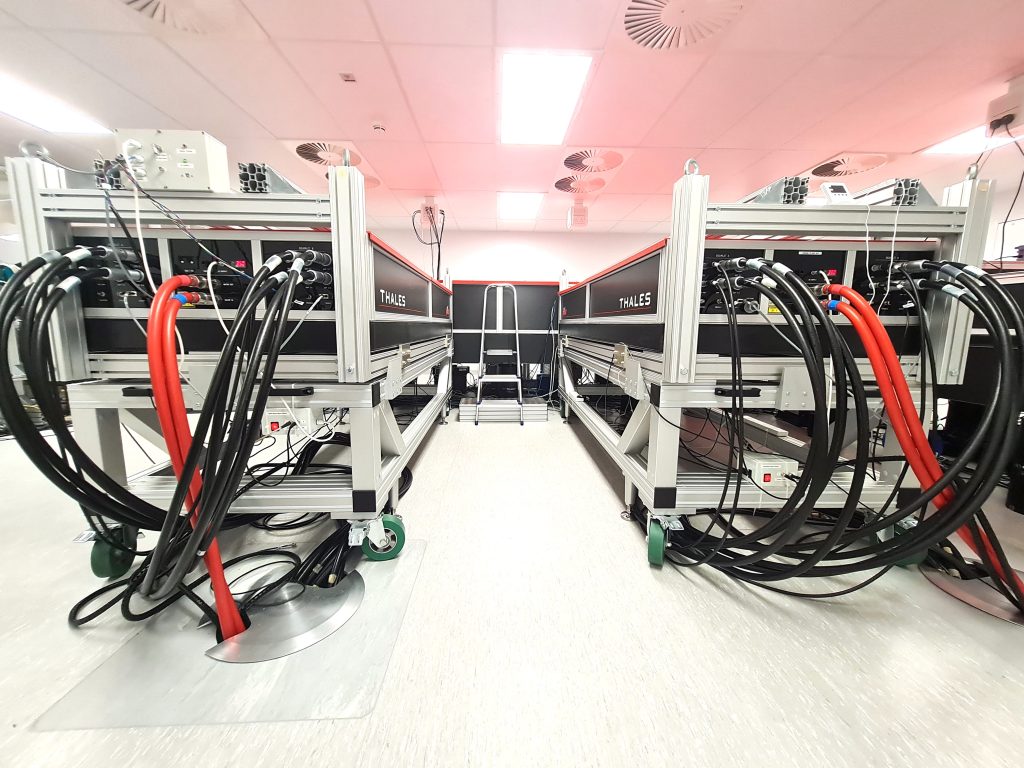
Unlike conventional accelerators, which typically use radio-frequency electromagnetic fields to accelerate particles over extended distances, laser–plasma accelerators exploit the intense electric fields generated when powerful, ultrashort laser pulses interact with plasma. These fields can be many orders of magnitude stronger than those in conventional accelerator structures, offering the potential to accelerate particles over much shorter distances.
How does laser–plasma acceleration work?
When an intense, ultrashort laser pulse propagates through a plasma, it drives a large-amplitude plasma wave. Electrons can be trapped in this wave and accelerated to very high energies over a short distance. This mechanism is known as laser wakefield acceleration (LWFA).

Laser–plasma interactions can also generate energetic protons and ions through different acceleration mechanisms, depending on the laser parameters and target properties. By controlling the laser pulse, plasma conditions and target design, researchers can investigate and optimise the properties of the resulting particle beams.

Particle acceleration at SCAPA
SCAPA operates high-power femtosecond laser systems and dedicated experimental beamlines for the development and application of laser-driven particle acceleration. Our research encompasses electron acceleration, proton and light-ion acceleration, and the development of advanced particle and radiation sources.
Electron beam acceleration
SCAPA’s laser wakefield accelerator research has demonstrated stable, high-quality electron beams with energies of hundreds of mega-electronvolts (MeV), reaching approximately 400–600 MeV in reported experiments. These beams can be used to drive secondary radiation sources and support research requiring energetic, ultrashort electron bunches.

Proton and ion beam acceleration
We investigate laser-driven proton and light-ion acceleration, focusing on the underlying physical mechanisms and the control of beam properties. Research into target design, beam transport, diagnostics and source optimisation supports the development of these sources for scientific, medical and industrial applications.
Developing next-generation accelerators
Our research explores ways to improve particle energy, beam quality, stability, reproducibility and source performance. These developments are important for making laser-driven accelerators more reliable and useful for applications beyond fundamental accelerator physics.
Applications of laser-driven particle beams
Radiation sources
High-energy electron beams can generate intense X-ray and gamma-ray radiation through interactions with plasma structures, magnetic fields and other targets. These sources can enable ultrafast imaging, diffraction and spectroscopy, allowing researchers to investigate rapid physical, chemical and biological processes.
Radioisotope Production
Electron beam-driven gamma-rays are used to induce photo-nuclear reactions in target materials (including radioactive targets). These pilot studies demonstrate the feasibility of laser-driven radioisotope production for medical imaging, therapeutic and theranostic applications.
Medical and biological research
Laser-driven particle and radiation sources offer opportunities to investigate radiobiology, radiation effects in biological systems and advanced imaging techniques. Research into high-dose-rate irradiation and compact radiation sources may also contribute to the development of future medical technologies.
Space radiation and electronic components
Energetic particles and radiation are important considerations in the design of spacecraft electronics and future space-based computing systems. Laser-driven sources can support experiments investigating radiation-induced effects in semiconductor devices and electronic components, helping researchers evaluate their sensitivity and reliability under selected irradiation conditions.
Materials science and industrial applications
Energetic particle beams and secondary radiation can be used to investigate material properties, radiation damage and the behaviour of matter under extreme conditions. Potential applications include the development and testing of advanced materials, radiation detectors and technologies for challenging environments.
Advancing accelerator science through collaboration
SCAPA brings together expertise in high-power lasers, plasma physics, accelerator development, beam diagnostics and radiation science. Through collaborations with academic researchers, industry and other research facilities, we aim to advance laser-driven accelerator technology and translate its unique capabilities into practical scientific and technological applications.
Our experimental infrastructure provides opportunities for collaborative research into particle acceleration, radiation-source development and emerging applications of high-intensity laser–matter interactions.