
Ion Beam Acceleration
The Scottish Centre for the Application of Plasma-based Accelerators (SCAPA) investigates laser-driven ion acceleration as a route to generating energetic ion beams using intense laser pulses. This approach offers the potential for compact ion sources with ultrashort pulse durations and high peak currents, opening up opportunities for scientific research and future applications.
When an intense laser pulse interacts with a solid target, it can generate strong electric fields that accelerate ions to high energies. One important mechanism is target normal sheath acceleration (TNSA), in which laser-accelerated electrons create an electric field at the rear surface of the target, driving ions forwards. The resulting ion beams can have broad energy spectra, high particle numbers and short pulse durations. Their properties depend on laser parameters, target characteristics and the acceleration mechanism.
Laser-driven ion beams have potential applications in proton radiography, ultrafast studies of matter, nuclear physics, radiation biology and the development of compact particle sources. They are also of interest for investigating high-energy-density physics and exploring future approaches to particle therapy, although substantial development is required before many clinical applications become practical.
Research into laser-driven ion acceleration aims to improve beam energy, spectral quality, stability and reproducibility, helping to establish the capabilities and limitations of this emerging technology.
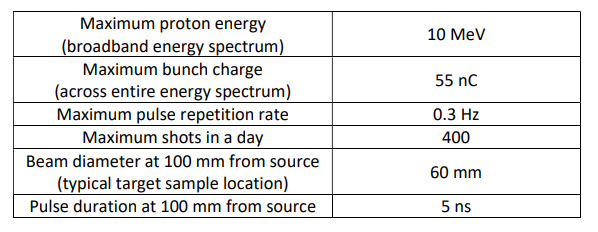
The nominal ion beam parameters at SCAPA are summarised below.
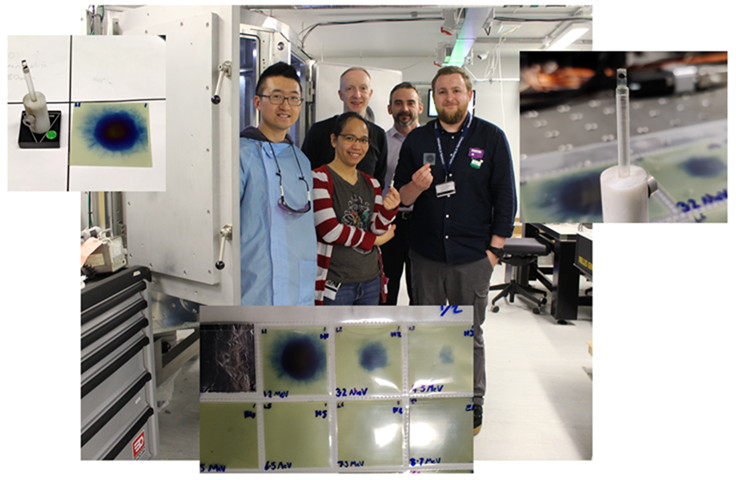
The first proton beam from beam Line B.