

Electron Beam Acceleration
The Scottish Centre for the Application of Plasma-based Accelerators (SCAPA) develops advanced laser wakefield acceleration (LWFA) techniques to produce high-energy electron beams from compact plasma accelerators. This approach offers the potential to significantly reduce accelerator size while providing unique beam properties for scientific research and future applications.
Laser wakefield acceleration uses an intense, ultrashort laser pulse to drive a plasma wave. The strong electric fields within this wave can accelerate electrons to relativistic energies over just a few millimetres to centimetres, far shorter than conventional accelerators. The resulting electron beams can feature ultrashort pulse durations, high peak currents, low transverse emittance and narrow energy spread.
At SCAPA, notable achievements include the production of stable, high-quality electron beams with energies of 400–600 MeV, very narrow energy spread and low transverse emittance. These properties make laser-driven electron beams promising for applications including compact radiation sources, ultrafast electron imaging, time-resolved electron diffraction and advanced accelerator research.
Research at SCAPA focuses on improving beam quality, stability and reproducibility, advancing laser-plasma accelerator technology towards reliable operation and a wider range of applications.
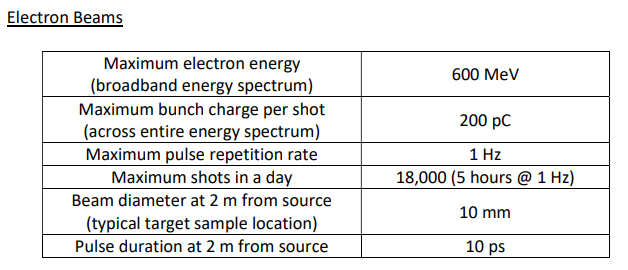
The nominal electron beam parameters achievable at SCAPA are summarised below.
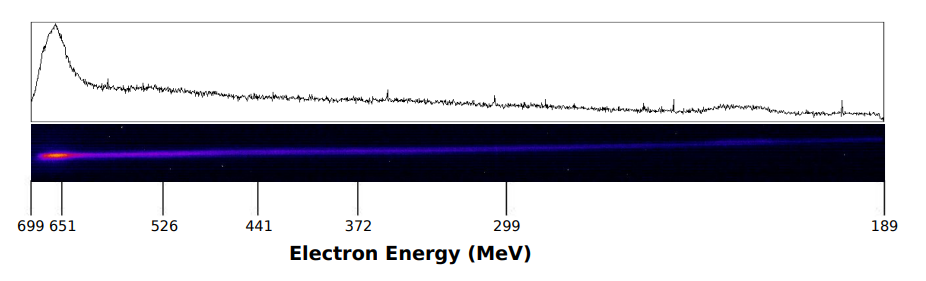
Below shows the spectrum of an Electron Beam with the peak energy around 664MeV. It was accelerated with a 6mm gas nozzle and 5.5J laser energy on target.
Below shows 100 Consecutive Shots of Electron Beam with peak energy around 400-500MeV. It was accelerated with a 6mm gas nozzle and 4J laser energy on target in A3 Beam Line
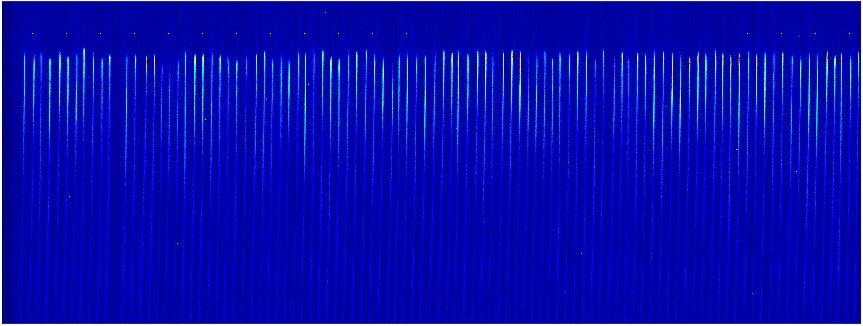
1500 Consecutive Shots of Electron Beam with peak energy around 500MeV. The laser was running at 1 Hz.


